


Overview
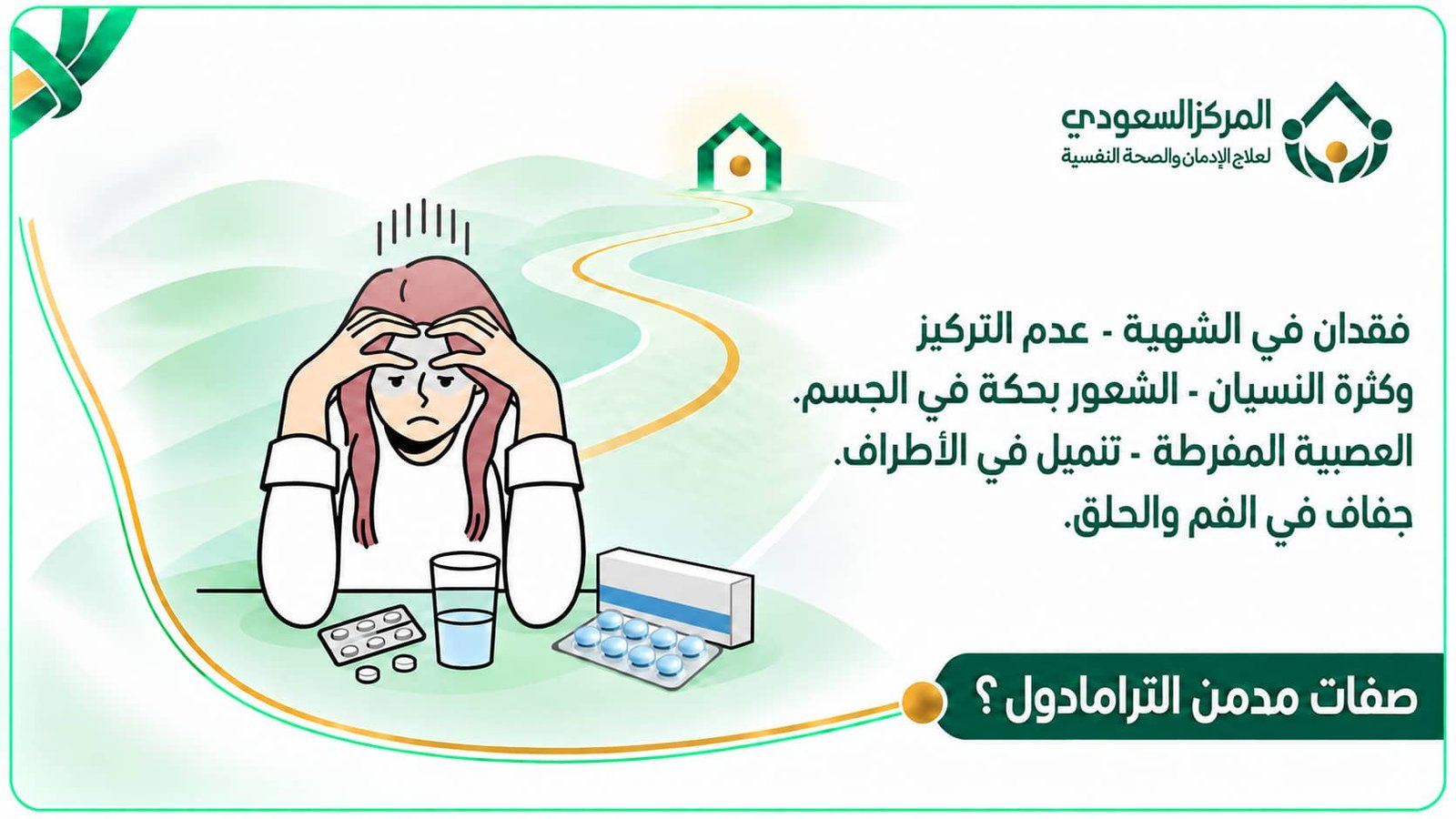
Traits of a tramadol addict often appear in losing control over the dosage, preoccupation with obtaining the medication, and continuing use despite harm to work, relationships, or daily responsibilities. This may be accompanied by hiding pills, justifying increased dosages, and mood swings, but these behaviors alone do not confirm addiction; evaluation depends on the full pattern and its impact on a person's life.
A person may appear tired, drowsy, or less focused, but appearance alone does not reveal addiction. Some individuals maintain their appearance and work life for a long time, while the problem becomes clearer in their relationship with tramadol and their ability to control it. Official pharmaceutical information confirms that tramadol carries risks of addiction and misuse, but diagnosis is not based on facial or eye appearance.
Understanding this picture helps the family deal with the problem without injustice or denial: do not turn behavior into a judgment on the person's morals, nor ignore loss of control just because their appearance is still normal. The most important thing is to know what to watch for, how to open clear dialogue, and where support ends and enabling the continuation of addiction begins.
On this page6 topics — jump to what interests you
Key pointsA quick look before the details
- The clearest traits are seen in loss of control, preoccupation with tramadol, failure to reduce use, and persistence despite harm.
- Irritability, lying, or isolation alone do not prove addiction, nor do they describe the personality of everyone experiencing them.
- A person may seem drowsy or tired, but there is no fixed appearance that can be used to diagnose tramadol addiction.
- To deal correctly with a tramadol addict, discuss the facts you have observed, suggest a specific step, and set boundaries you can enforce.
- In the case of a husband addicted to tramadol, the wife needs to support him to seek help while protecting herself, the children, and the household finances.
- Giving him money, covering for his absences, monitoring him constantly, and insulting him do not solve the problem and may increase family conflict.
What Are the Traits of a Tramadol Addict?
View details+
What Are the Traits of a Tramadol Addict?
Traits appear of a tramadol addict in changing relationship with the drug; they find it difficult to adhere to the dosage, tramadol occupies an increasing part of their thoughts and time, and they continue using despite causing problems in health, work, or relationships. This may be accompanied by hiding pills, justifying doses, or becoming agitated when discussing use, but these behaviors alone do not prove addiction.
Sample numbers to illustrate the design
More accurate medically is not to label the person with fixed traits like "liar" or "irresponsible." Use disorder may affect decisions, priorities, and behavior, but it does not erase their personality nor make every bad behavior a sign of addiction. Clinical evaluation depends on a clear pattern combining loss of control, preoccupation with the drug, and continued use despite harm, not on family impression or a single trait.
Stages subject to change according to the article content
-
Optional time or date
Title of the first stage
A brief description appropriate to the article's topic.
-
Title of the second stage
A flexible space to explain this stage and add details the reader needs, while maintaining clarity of sequence.
-
Title of the third stage
The title and text can be changed according to the content.
-
Title of the fourth stage
A concluding description of the stage, with the possibility to add other information.
-
Title of the fourth stage
A concluding description of the stage, with the possibility to add other information.
-
Title of the fourth stage
A concluding description of the stage, with the possibility to add other information.
help Control by providing and this is a condition that may rapidly worsen and requires urgent medical evaluation.
A person may decide to stick to a certain number of pills, then find themselves exceeding the dose or taking it earlier than planned. They may try to reduce multiple times but return to previous amounts or increase them when feeling pain, distress, or fear of stopping.
An increase in dosage alone does not mean a person is addicted; physical tolerance may develop in some who use opioids medically. What is notable is repeated loss of control: taking larger amounts or for longer than intended, or failing to reduce use despite efforts. These signs are among criteria used to assess opioid use disorder.
In daily life, family may notice agreements on dosage do not last, the person requests prescriptions early, or justifies increases as exceptional cases. One incident is not enough to judge, but repetition of the pattern deserves serious evaluation.
Becomes preoccupied with tramadol and obtaining it
As the problem develops, tramadol is no longer just a medicine used and whose effect ends, but becomes present in thought and planning: how many pills are left? Where to get more? What to do if the dose is unavailable?
Sequence from right to left
-
Optional time or date
Title of the first stage
A brief description clarifying this stage.
-
Title of the second stage
A space to add details that suit the article's topic.
-
Title of the third stage
The text changes according to the displayed content.
-
Title of the fourth stage
Concluding description of the final stage.
The person may change plans because of the drug, spend increasing time obtaining, using, and recovering from its effects, or become noticeably anxious as pills run out. Spending significant time on opioid-related activities, along with craving, is an important indicator in clinical evaluation.
This preoccupation sometimes explains why matters once important decline. It does not mean they stopped loving their family or caring about work, but the drug started occupying more space in decision-making.
Optional introductory description

Title of the first feature
A brief description explaining this feature and its relevance to the article's topic.
Title of the second feature
Space to explain another point of distinction in clear and direct terms.
Title of the third feature
The title, description, and icon can be changed to suit the content.
Title of the fourth feature
Here is displayed a benefit or reason that helps the reader understand the topic.
Hides use Or Changes how they talk about and this is a condition that may rapidly worsen and requires urgent medical evaluation.
Some cases hide packages, deny the number of pills used, or offer more than one explanation for obtaining them. The person may promise to stop until the discussion ends, then return to use away from the family.
These behaviors harm trust but require precision in description. Hiding or denial may be attempts to avoid blame, protect continued use, or arise from the person's own lack of recognition of the problem's magnitude. It is therefore more useful to observe facts: Have pills disappeared? Has the dose increased? Have there been repeated attempts to stop? Has use continued despite harm?
Opinion of the doctor: Do not turn confronting hiding into a moral judgment. Discuss observable behavior and its consequences because talking about doses, absences and failed quit attempts is closer to assessment than arguing about calling it lying.
Responsibilities decline and regular intake of tramadol according to a medical prescription does not mean that the patient has become addicted. Also, the appearance of withdrawal symptoms when delayed in taking it may indicate physical dependence that requires gradual reduction under medical supervision, but it alone does not prove addiction. The concern increases when the repeated need for the drug is combined with strong desire, difficulty controlling use, and continuation despite harm.
The change may begin with repeated lateness to work, neglecting a household task, or gradual withdrawal from the family. Then the problem widens to include financial disputes, frequent absence, or loss of interest in activities the person used to enjoy.
Price, button, and badge are optional fields
First Option
Brief description of the option
-
First Item
Brief description
-
Second Item
Changeable details
-
Third Item
Additional information
Second Option
Brief description of the option
-
First Item
Brief description
-
Second Item
Changeable details
-
Third Item
Additional information
These changes alone do not confirm addiction; they may result from depression, illness, or life pressures. But they become more indicative when they appear alongside loss of control over tramadol and continued use despite the person knowing its effects at home and work.
Item-by-item comparison
| Comparison aspect | First Item | Second Item |
|---|---|---|
| Definition | Brief description of the first item. | Brief description of the second item. |
| Features | Basic features in brief. | Corresponding features in brief. |
| use | When is this option used? | When is the other option used? |
| Notes | Additional details to aid understanding. | Other details that support comparison. |
Definition
First Item: Brief description of the first item.
Second Item: Brief description of the second item.
Features
First Item: Basic features in brief.
Second Item: Corresponding features in brief.
use
First Item: When is this option used?
Second Item: When is the other option used?
Notes
First Item: Additional details to aid understanding.
Second Item: Other details that support comparison.
The criteria for opioid use disorder include neglect of commitments, continuing despite social problems, giving up important activities, and continued use despite knowing its physical or psychological harm.
Optional introductory description
Do
-
First guideline
A brief clarification of what is advised to do.
-
Second guideline
A practical step relevant to the article topic.
-
Third guideline
A guideline that can be customized according to the content.
Avoid
-
First behavior
A brief clarification of what is preferred to be avoided.
-
Second behavior
A brief explanation of what should be paid attention to.
-
Third behavior
A practical alert related to the article topic.
At this stage, the family may feel that the person has completely changed. This feeling is understandable, but dealing with them as a person suffering from a treatable disorder opens a better door than reducing them to the behavior exhibited during addiction.
His mood fluctuates His mood becomes more defensive
The person may appear calm or lethargic after taking the dose, then become quick-tempered when it is delayed or when the family asks him about the pills. He may withdraw from conversation, refuse any discussion, or treat remarks as accusations.
Common information
Here is written the common idea that needs clarification.
For review and clarificationCorrection
Here is written the more accurate information directly and clearly.
Why?
Here is added a short paragraph explaining the reason for the correction and placing the information in context.
Nervousness alone is not a characteristic of of a tramadol addict tramadol that can be used to judge; it may be related to pain, sleep disorder, psychological stress, or another health condition. But it becomes part of the picture when it recurs alongside preoccupation with the drug, concealment, loss of control, and decline in responsibilities.
Here is written a documented quote illustrating an idea related to the article topic.
A clinical study on patients with long-term dependence on tramadol found an increase in some psychological and behavioral symptoms, such as anger, aggression, anxiety, and depression, but the results of a specific treatment group do not mean these traits appear in every addict or are sufficient for diagnosis.
What does a tramadol addict look like?
View details+
What does a tramadol addict look like?
The appearance of of a tramadol addict tramadol may look fatigued or drowsy, with slow movement and response and poor concentration, and the pupil may constrict in some cases. But there is no fixed facial or body appearance that proves a person is addicted, and some of these signs can appear in a patient taking the medication as prescribed.
The official drug leaflet explains that tramadol may cause dizziness and drowsiness and affect the ability to drive and operate machinery, as well as carrying risks of misuse, dependence, and overdose. But this information describes the drug's effects and risks and does not make appearance a means to diagnose use disorder.
Here is presented a summary of the research result clearly and briefly.
Study context and result limitations are added when needed.
Facial and eye features
The gaze may appear less focused, or laziness may appear on the face, or the person may find it difficult to follow the conversation. Constriction of the pupil may occur due to the opioid effect, but pupil size is also affected by lighting, some medications, and health conditions, so it is not a standalone indicator.
There is no single 'addict's features' to compare with an image on the internet. Some people clearly show the effects of the dose, while others maintain a normal appearance despite an advanced use disorder.
Movement and concentration
The person may move slowly, be delayed in responding, or appear unsteady while walking. They may doze off while sitting or face difficulty in a task requiring attention, especially if the dose is high or tramadol is used with other substances affecting the nervous system.
But these signs illustrate the drug's effect at that moment more than indicating addiction. A patient may feel dizzy after a prescribed dose without suffering use disorder, while another person may hide the problem and not appear drowsy every time.
Care for appearance and hygiene
The person's interest in clothes or cleanliness may decline when the problem dominates their day and responsibilities deteriorate, but this is not a change exclusive to tramadol and does not appear in all cases. Neglect of appearance may also be related to depression, illness, or other social and psychological conditions.
The shape of the teeth, weight, or complexion is not specific evidence of tramadol addiction. If a change in appearance appears, it is read within the broader picture: Have the doses increased? Has stopping become difficult? Have responsibilities and relationships been affected?
يمكن للمظهر أن يلفت الانتباه، لكنه لا يحسم المشكلة. لا تنتظر أن يبدو الشخص بالصورة النمطية للمدمن، ولا تتهمه اعتمادًا على العينين أو الوجه. ابحث عن نمط فقدان السيطرة والاستمرار رغم الضرر، ثم اطلب تقييمًا متخصصًا.
How to deal with a tramadol addict
View details+
How to deal with a tramadol addict
In order to deal with of a tramadol addict Tramadol correctly, you must choose the right time to be He is aware and calm, then discussing the changes as you noticed Without insult, and suggesting a therapeutic step, with setting clear boundaries that protect the family of the continuation of harm.
These steps may seem easy on paper, but they become more complicated inside a home filled with anxiety, repeated promises, and conflicts. The family may have reached a stage where finding pills or missing money is enough to ignite a new confrontation. Therefore, the success of the dialogue is not measured by eliciting immediate confession, but by its ability to move the problem from denial and accusation to evaluation and treatment.
Opioid use disorder is a treatable medical condition, and there is no one plan that fits all individuals. The more the discussion shifts from blaming the person to identifying behavior, harm, and the next step, the more realistic it becomes to access help.
Choose an appropriate time for dialogue
Do not start the conversation when the person is very sleepy, confused, angry, or clearly under the influence of tramadol. At that moment, they may not comprehend what you say, and the dialogue might turn into denial or shouting without anyone approaching a solution to the problem.
Wait until they become more aware, and choose a quiet place away from children. Do not gather many family members around them; feeling trapped may push them to defend themselves instead of thinking about what they hear.
The dialogue can begin like this:
We have noticed the doses increased, and you tried more than once to reduce but couldn't, and your work and home life have been affected. We are worried and want to go with you to a specialist who understands what is happening and determines the safe step.
This sentence does not ignore the problem, but it focuses on facts instead of attacking the person.
Talk about about the behavior that you saw Not about not their character
The family may be angry about concealment or promises not fulfilled, and this is an understandable feeling. But phrases like “You are a liar” or “You don’t care about anyone” shift the conversation from tramadol use to a battle over morals, and often the discussion ends without a decision.
Choose two or three facts that can be clearly identified, such as:
- Increasing doses beyond what was agreed upon.
- Missing pills or money.
- Frequent absence from work.
- Failed attempts to stop that did not last.
- Driving a car while drowsy or confused.
- Continuing use despite a clear health or family problem.
Do not try to review the entire history of the relationship or prove every previous situation in one session. It is enough to clarify the pattern that has become harmful, then move on to what should be done now.
المواجهة الناجحة لا تجعل الشخص يخسر كرامته حتى يعترف بالمشكلة. الحزم الحقيقي هو أن تصف الضرر بوضوح، وترفض استمراره، وتعرض طريقًا عمليًا للعلاج دون إذلال أو تهديدات فارغة.
Listen require Reason Their attachment with tramadol
The person may say they need tramadol because of pain, or because they cannot sleep or work without it. Their words may seem like mere excuses to the family, but they may reveal an important part of the problem.
Some cases start with a legitimate prescription, then the doses gradually increase. The medication may become a way to escape psychological distress or to avoid withdrawal symptoms that appear when the dose is delayed. Listening to these reasons does not mean accepting continued use; rather, it helps understand what the medical plan must address besides the use disorder itself.
Do not let disagreement over the word "addict" obstruct access to care. The label can be temporarily set aside by saying:
Whether you consider it addiction or not, the dose has increased, stopping is harder, and clear harm has appeared; this deserves a specialized evaluation.
Clinical guidelines encourage cooperation with the patient regarding their safety because participation in decision-making may increase the likelihood of accepting intervention and treatment.
Suggest a Specific Instead of Demanding That «Invalidates»
The person may agree under pressure and say they will stop, then find themselves the next day facing pain, strong cravings, or fear of withdrawal. Therefore, general advice or verbal promise is not enough.
Turn the dialogue into a clear action:
- Schedule a medical evaluation appointment.
- Contact a specialist doctor in addiction treatment.
- Go with them to the appointment.
- Prepare the names of medications and doses they use.
- Inform the doctor of any loss of consciousness, seizures, or mixing with other substances.
- Do not change the dose or stop tramadol suddenly before evaluation.
The family can say:
We are not asking you to solve everything today, but we request to start with an evaluation that clarifies the magnitude of the problem and the safe way for treatment.
This proposal provides a doable step instead of confronting the person with a huge and vague task that could increase their fear or resistance.
Set Boundaries boundaries It can Implement them
Support does not mean the family bears all the consequences of use instead of the person. They may give money fearing their anger, pay debts, justify absenteeism from work, or hide the problem to protect their image in front of others. While these actions may come from love, they might lessen the consequences that could have compelled them to seek treatment.
Family boundaries can include:
- Not giving money to buy tablets.
- Not lying to cover for absence or problems.
- Securing the family's income and children's needs.
- Keeping medications in a place inaccessible to children.
- Refusing to drive when drowsy or confused.
- Not leaving children in their care if unconscious or unable to act safely.
Boundaries must be realistic. Do not use threats you cannot enforce, and do not change your decision whenever the person becomes angry or promises to stop. Boundaries are not punishment; they are a way to reduce harm and clarify that the family will not support continued use.
SAMHSA guidelines explain that substance use disorder affects communication, roles, and routines within the family, and that involving the family in treatment in an organized manner can improve engagement, adherence, and treatment outcomes. A systematic review also found that integrating family members into substance use disorder treatment may help reduce use and improve family functioning, though the strength of evidence varies between interventions and studied groups.
Not turn into require monitor permanent
Fear may drive a family member to constantly search through phones, clothes, and containers. This might uncover some information, but it does not give the family control over the addiction, and it may turn the home into a continuous chase between monitoring and hiding.
Focus on safety and actual decisions:
- Is he driving under the influence?
- Can he take care of the children?
- Is household money used to buy pills?
- Has he agreed to an assessment?
- Have signs of overdose appeared?
- Is he adhering to the agreed treatment steps?
The family can protect the home and encourage treatment, but they cannot monitor the person around the clock or guarantee his choices. NICE standards also recommend assessing the needs of family members and caregivers themselves, not just treating them as tools for monitoring the patient.
In the case of a husband addicted to tramadol
View details+
In the case of a husband addicted to tramadol
the Case husband addict by providing tramadol, we advise the wife to combine between encouraging him by providing treatment and protecting way and her children, Without That turn into require monitor permanent Or bear responsibility for his recovery alone.
She can choose a safe and calm time, then link her concerns to specific situations inside the home.
The wife needs to protect four essential aspects:
Her personal safety:
If use is accompanied by threat, violence, or intimidation, do not confront him alone when he is angry or under the influence. Protection comes before dialogue, and one must move to a safe place and seek appropriate help if there is a direct danger.
The children:
Children are not to be used to pressure the father, nor are they to be asked to monitor him or look for pills. But they must be prevented from accessing medications, must not be left with an unconscious or incapable caregiver, and must be protected from riding with him while driving under the influence.
Household money:
The wife has the right to protect the family's basic needs if a portion of the income is spent on buying pills or paying debts related to use. The goal is not to humiliate or control the husband, but to prevent loss of food, housing, treatment, and children's needs.
Her mental health:
Living with addiction can put the wife in a continuous state of fear, doubt, and exhaustion. Receiving psychological or family support does not mean she has given up on her husband; rather, it helps her set clearer boundaries and make less impulsive decisions. Guideline sources emphasize that family members also need assessment and support, and that family support may play an important role in the treatment and recovery journey.
Mistakes to avoid when dealing with a tramadol addict
View details+
Mistakes to avoid when dealing with a tramadol addict
Even with good intentions, shock and fear may drive the family to actions that increase tension and do not bring the person closer to change. The mistake may arise from anger, exhaustion, or the belief that harsh pressure will force him to stop.
To deal properly with a tramadol addict, it is not enough to know what to do; you also need to avoid what turns the relationship into a constant conflict or lessens the consequences of use in a way that helps him continue.
Confrontation He is Ineffective Capable by providing Dialogue
The family may find the pills and start the confrontation immediately, while the person is drowsy, distracted, or highly agitated. At this moment, it is difficult for him to hear what is being said or to discuss calmly, and the conversation often turns into denial, shouting, and mutual accusations.
When there is no immediate danger, it is better to postpone the talk to a time when he is more aware and stable. The goal is not to choose a perfect moment, but to avoid a moment that does not allow any useful discussion at all.
Family members may think that postponing confrontation is weakness or retreat, while in reality it is a choice of timing that increases the chance of listening. Supportive communication that is not judgmental helps discuss the use disorder as a condition that needs care, not a moral fault that must be exposed.
Insulting him Instead of discussing His behavior
After repeated hiding and promises, the family may say harsh words they do not mean under normal circumstances. But when they describe the person as a failure or immoral, the conversation shifts from the tramadol problem to defending dignity and the relationship.
There is a big difference between saying:
You don't care about us and think only of yourself.
And saying:
The doses have increased, work is affected, and household finances have become unstable; the situation cannot continue this way.
The second sentence does not lessen the severity of the problem, but it makes the harm clear and open to discussion. Substance use disorder is a medical condition, not proof of corrupt character, and therefore it is preferable to use language that maintains respect for the person without justifying the behavior.
discussing For all Mistakes the Session One
When the family starts talking, years of disputes may be opened: money, absence, lies, relationships, and past situations. After a few minutes, it becomes difficult to know whether the discussion is about tramadol or marriage, upbringing, or the entire past.
It is better to select two or three facts directly related to the use, such as increased doses, disappearance of money, or repeated absences. Then state the required step clearly.
This does not mean that the other problems are unimportant, but collecting all of them in one session may distract from the goal and make the person feel that they must defend their entire life, not discuss a specific problem.
Dependence by providing Promises alone
The person may promise to stop and appear at that moment honest and convinced. The family may cling to the promise because they are exhausted and want to believe the crisis is over.
But the promise alone does not change the pattern that appeared, nor does it clarify how the person will deal with pain, craving, or fear of stopping. Therefore, words should not be treated as a complete solution, nor should failure after the promise be considered definite proof of deception.
The most useful is to turn the promise into a measurable step:
It is good that you want to stop. What step shall we take now so that it does not remain just a promise?
The motivation to change is important, but it may change over time; therefore, motivational therapeutic methods work to strengthen readiness and turn it into practical behavior, not just a momentary statement.
Giving him Money To avoid His anger
The family may demand calmness at any cost, so they give him money so he does not go out or cause trouble. They may convince themselves that the amount is small or that refusal will increase tension in the household.
But repeating this may cause the family to fund the use while trying to avoid its consequences. Conversely, setting boundaries does not mean depriving him of food, treatment, or basic needs.
The family can help with something clear and direct, such as paying for a necessary service themselves instead of giving him money without knowing where it will go.
Boundaries are not used to humiliate him or control every detail of his life; rather, they protect the family and prevent money from becoming part of continuing the problem.
Covering up His absence And his problems Always
The wife may contact his workplace and invent an excuse, or the family may pay off a new debt, or hide the problem each time to avoid damaging his reputation. At first, this seems like protection for him, but it may distance him from facing the consequences of his use.
Proper support helps him bear responsibility, while repeatedly covering up the consequences may delay his realization of the extent of the harm.
The intention is not to let him collapse or to publicly shame him, but rather to stop bearing the entire burden in his place. Family therapy guidelines focus on roles, relationships, and communication patterns within the family, because the way those around respond may affect the persistence of the problem or the approach to treatment.
Monitoring All the time
When the family loses trust, the whole day may revolve around questions: Where were you? What did you take? Why are you late? What are you hiding? Gradually, the wife or mother may become a constant monitor, while the person becomes more skillful at hiding.
This monitoring exhausts the family and does not grant them real control. It may be necessary to follow up on matters related to money, children, or safety, but trying to know every move and every dose makes the relationship based on a chase.
In the case of a husband addicted to tramadol, we advise the wife not to make her whole life about monitoring him; her primary responsibility is to protect herself and her home, and to clearly express her boundaries, not to monitor her husband twenty-four hours a day.
The wife herself may need support, especially if she begins to suffer from anxiety, insomnia, or isolation. Guidance sources affirm that the family is not merely a tool to help the affected person, but may also need counseling and support due to the impact of the disorder on relationships and daily roles.
Issuing threats Not It can Implement them
The family may say in a moment of anger:
This is the last time, and if it happens again we will leave you immediately.
Then the situation repeats and nothing happens, so the threat loses its meaning. Over time, the person knows that the words are said in anger and then forgotten.
An effective boundary is not the harshest, but the clearest and most enforceable. For example, one can say:
We will not give money to buy pills, we will not cover absences, and we will protect the household income and the children’s needs.
These are specific boundaries, while general threats open new conflicts and do not clarify what will actually change.
Forcing by providing recognition with a word «of a tramadol addict»
Family members may spend the entire conversation trying to force him to say he is addicted, while he rejects the word and insists the problem is under control.
Recognition of the label is not the primary goal. More important is to discuss the facts:
- Have the doses increased?
- Have efforts to reduce failed?
- Has the home or work been affected?
- Has the medication become dominant over his day?
Change can begin even before everyone agrees on the name. When arguing over the label is used instead of talking about harm, linguistic rejection may become a way to escape the main issue.
Shifting the wife require the sole responsibility about for his change
In the case of a husband addicted to tramadol, the wife may feel that she must find the right phrase, monitor doses, protect him from consequences, and repair his relationship with work and children. When he does not change, she blames herself and thinks she did not handle him correctly.
This is a burden no single wife can bear. She can encourage him, set boundaries, and protect the family, but she cannot make the decision to change for him.
Supporting him does not mean canceling her life or accepting unlimited harm. Also, seeking family or psychological help is not a sign of marriage failure, but a means to protect her ability to think and make decisions.
What is the most balanced approach?
View details+
What is the most balanced approach?
Balanced handling is not based on indulgence nor continuous confrontation. Express the facts clearly, do not insult the person, do not finance their use, and do not bear all the consequences instead of them. Set boundaries you can enforce, and leave responsibility for decisions to him.
The situation may not change after one conversation. This does not mean the dialogue failed, nor that the family is required to repeat it daily. Sometimes the first progress is that the problem becomes clear, the family stops covering for it, and the person knows that support is available but continued harm will not be treated as normal.